Hey folks, Cort, N0MJS here – not Joe this time. Since I have had the RC-96 in my possession for a few weeks now, we decided to extend the blog posting a bit more. I do not have Joe’s sense of humor, so I’ll not try to replicate the things in his posts that make me laugh. You’ll get far less humor from me, I’m afraid.
Let me introduce myself in terms of my relationship to KE0FF. I met him when I was in undergraduate school, 200 miles away from where he was working post-graduation. The common link was my brother, Gavin, N0ECQ (SK). So something like 35 years ago? Gavin somehow talked Joe out of an indefinite loan of his (first-build) FF-80 controller, and then I talked him out of one of the first FF-800s built on vector prototype board and some weird 3M mini “punch down” type socketing parts. All of this to set the stage…
The point of this post is not about building the RC-96, so if you’re hoping for more interposers and pico-ohm meters, you might just hit the back button now. I wanted to share my experiences getting a brand new controller that’s a design about as old as my relationship with Joe and what I learned connecting it to a repeater. When I was a young ham (licensed a few years and in the earlier part of my 20s), I will admit to coveting ACC controllers. I’d read the tiny one-page add in the ARRL Repeater Directory (anyone remember that?) and dream. ACC was what all of the really well funded clubs had, and they all seemed to sound great, even if many talked a little too much.
So, this is where I start. An FF-80, FF-800, SCOM 5k, RLC-Club Deluxe, CAT200, and finally an SCOM 7330 before settling into a few Arcom RC-210s over the last 20 years… of them all, never an ACC.
SCOM may have been a more parallel evolution, but it would be difficult to say the massive popularity of ACC did not contribute to their direction for on-the-air behavior, even if their user interface remained a remarkably different arrangement, awesome in its own right.
Please don’t take what comes next as a slam on ACC. All of the products I’ve listed here are an evolution of the revolution they started. I was shocked when I started digging into the schematics and the manual. 10 static courtesy tones? Why does the audio delay need additional audio gating? Wait, there’s 1 audio output buffer amplifier? I have to supply my own COS active-low pull-up? I know this isn’t the RC-850, and along the way I learned more about the differences in ACCs controllers. Then after the initial let-down sank in, I started to realize just how much it did do. I also realised that it sounded good. Really good. Some of that I owe to Joe’s extra work on grounding at the DIN connectors but I was immediately quite happy with the audio.
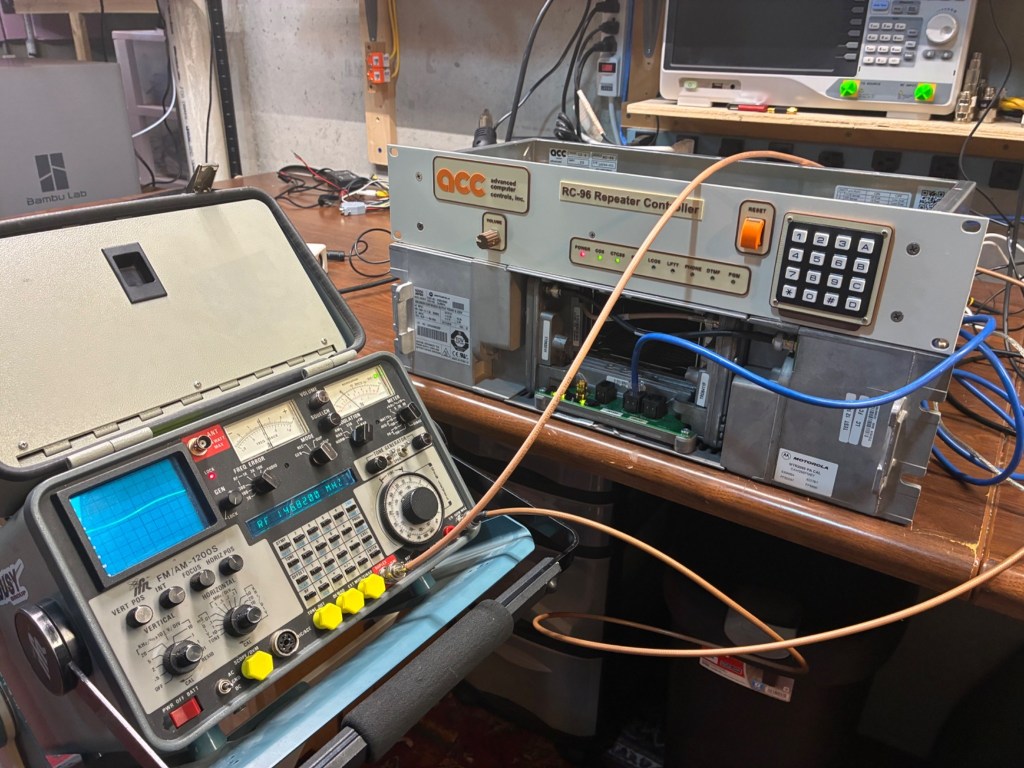
As of today, I have it interfaced with a Motorola MTR2000 (my favorite station of all time) and am using it on the bench. I found that buying pre-made DIN-DIN cables was the most cost and time effective way to interface it. I’m not sure where it will end up. I really would love to have on the air, on a repeater that gets, well… as much use as any of them seem to get these days, though I’m not sure how I’ll pull that off and keep it nearby so I can use it daily. I plan to interface the link port to a RoIP link (not ASL for those who will ask) to the KS-DMR network that I run (it started DMR, but now embraces multiple modes, including analog FM), assuming I can find a local home.
But more about hooking it up. I found that COS active-high, was actually easy and what I wanted. Since the MTR2000 outputs a true COS (carrier) and an RX Unsquelched lines as active high, it was time to eschew my love of open collectors and active low and just connect it this way. I’m running the RX unsquelched to the COS input, with the station set for carrier access, then a separate discriminator output to the CTCSS input feeding the RC-96 tone panel.
To my surprise, the MX365 decodes faster than the station’s internal decoder! But more to the point, I set it up this way so that, if some issue should arise with the use of the tone panel, I can put the MTR2000 back into tone access and let the RC-96 COS see the “and squelch” (to use an ancient Motorola term) from the station. I’ve left the CTCSS encode to the station since I really prefer to have the reverse burst squelch-tail elimination on the station’s transmit, while thanks to the audio delay board, I have universal STE for receive. Oh yeah – and that RSSI input? Yeah, it works! It works pretty well with the stock MTR2000 RSSI output – plug and play!
I’ve set up most of the operating parameters to my liking, and in so doing realized that the autopatch was the killer app back when the RC-96 was built, and unfortunately will sit totally idle today. I’ve built up IDs, figured out the macros and the scheduler. Yeah, this is pretty cool! And while it is limited in many ways, I was able to achieve just about everything I would have done with an FF-800 or an RC-210. And I just love that TI-LPC speech. It’s nostalgic, I know. Regardless, it will always have a special place in my heart.
I will likely have another post coming. Much like Joe, I’ve gone down the rabbit hole myself. I love the TI speech, but the vocabulary is limited. Wouldn’t it be great to have a DVR? I’d been working on a sort of “fox hunt” type module using an ISD Chipcorder for a friend who’s put together a half-day event he calls “radio rally” – a kind of mash up of emergency preparedness practice, fox hunt, and competition. While I was working on the device, I realized that it was really close to what I would need hardware-wise for a DVR for the RC-96. As it turns out, the only thing it really needed was software. For now, I’ve left out the voice mail and focused on ID and tail messages and user audio playback (you know the one where you can check how you sound into the repeater?)
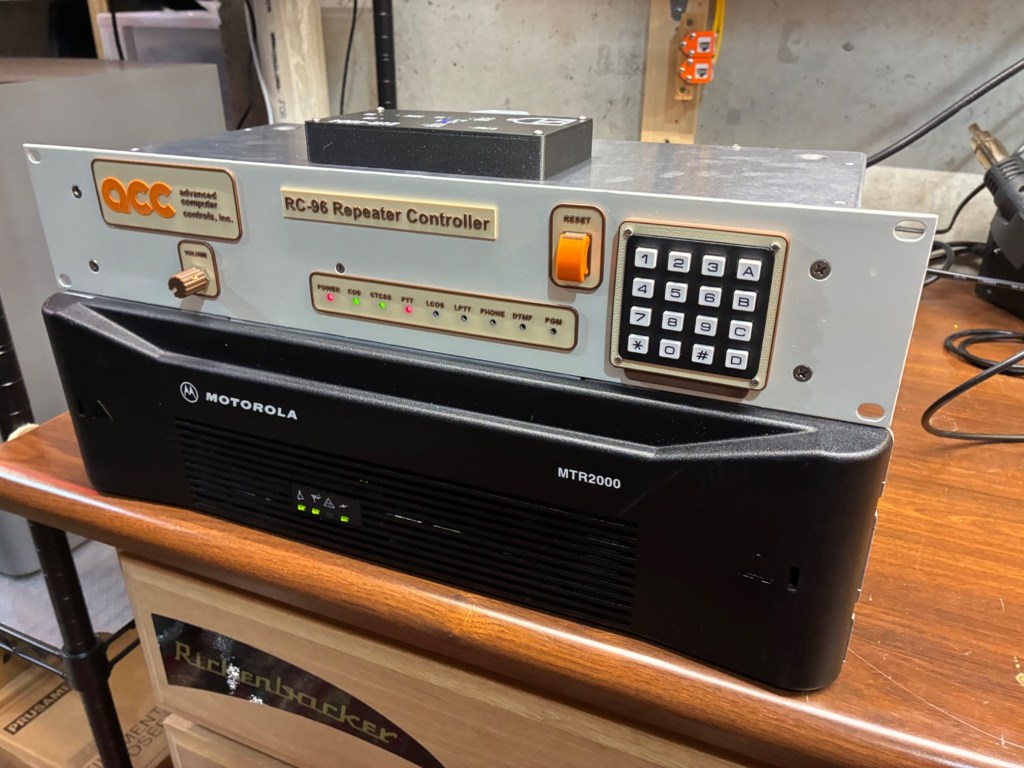
So no autopatch, no voice mail, and no remote base/link (yet), but otherwise, I’m doing about everything you’re supposed to do with an RC-96, including DVR-based IDs. Ah… it’s like 1990 all over again! Unfortunately, it is not at a real site yet, but I remain hopeful that I can find a home for it. Was the RC-96 everything that 20 year-old me thought it was? No, it wasn’t. Is the RC-96 everything I’d want in an analog FM repeater controller in 2026? Yeah, it really is most of what I want. I’d like user defined courtesy tones, a timer for courtesy tone delay… a few other “modern conveniences”, but if I’m going to be real honest, I’m not going to miss them when using the repeater on a daily basis. Would I have sought out an original ACC? No, I’d have just picked up another Arcom RC-210, but would I deploy a NEW RC-96 that just got built? Absolutely.
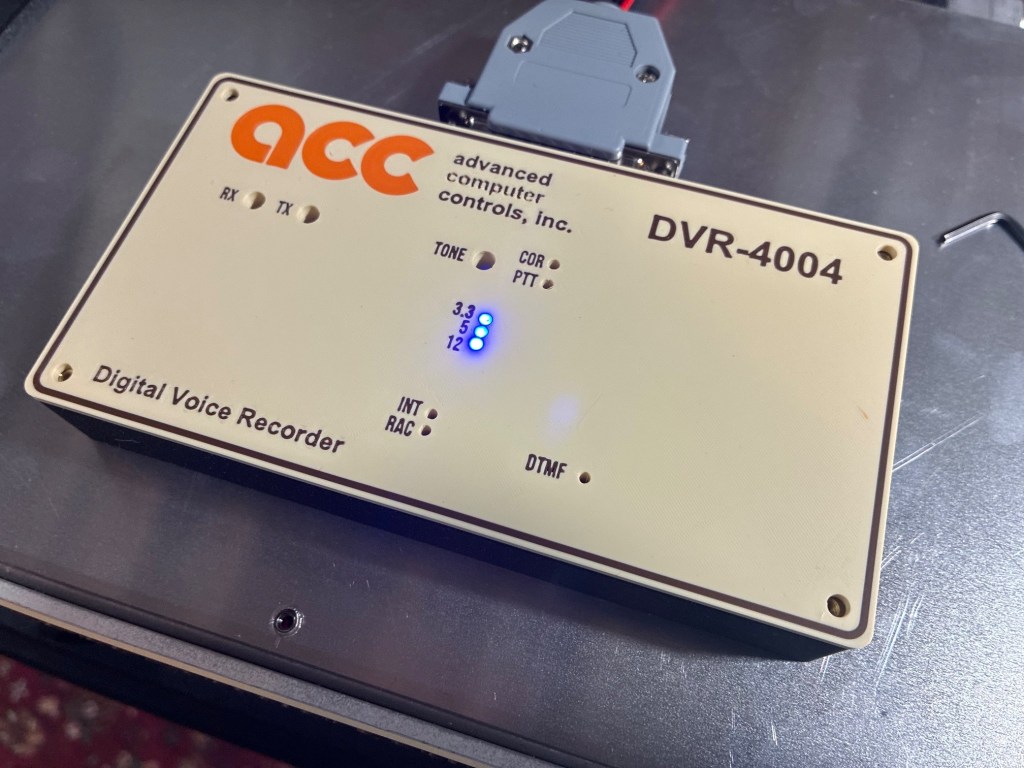
Perhaps the one thing I’ve not yet mentioned is the fun I’ve had working with the RC-96. Along the way, I’ve learned a lot about earlier controller design. I have an immense appreciation for just how much performance they were able to eek out of that 8085 MCU. It was a pleasure figuring interfacing it to the station and my DVR module, and hopefully, this thing is still running, somewhere, 35 years from now!
0x49, de N0MJS


Leave a Reply